Jan 2, 2014 | Prolotherapy, PRP, Spine and Neck
It may start as an aching sensation in your neck or back that fades and returns. The pain may increase and last longer over time. You may begin to lose flexibility and stretching or turning your back might increase the pain. If you have these symptoms, you might be suffering from facet syndrome.
Facet syndrome is a common diagnosis for back, mid-back and neck pain. The facet is a joint that lies between each of the vertebra in the back. These joints are in constant motion, providing the spine with both the stability and flexibility needed to walk, run, bend, sit, and twist. The joint surfaces are lined with cartilage allowing them to glide easily over each other. The joint can be become damaged from an injury, or due to a degenerative condition, such as arthritis. When the joint cartilage deteriorates, friction between the bones leads to the tenderness, swelling, stiffness, and pain. The muscles will also work harder to protect the injured area, becoming very tense and stiff.
Video: Understanding Facet Syndrome, Causes and Treatments:
[youtube id=”oxd6uSl7c0U” width=”560″ height=”315″]
Symptoms of Facet Syndrome
- Pain that is often worse in the beginning and end of the day, or with a change in weather
- Lower back pain that is primarily at the waist level
- Neck pain that radiates into the shoulders, or head
- Headaches at the base of the skull, aching behind the eyes, and/or ringing in the ears
- The sound of bone rubbing on bone when you move
- Abnormal curvature in the spine
- Increase in pain when first standing, when sitting for long periods of time, or when bending or twisting
Risk Factors for Facet Syndrome
- Excessive weight
- Back overuse due to sports or heavy labor
- Family history of facet syndrome or back pain
- Presence of disease such as gout, other types of arthritis, or infections
- Damage from injuries, including whiplash, or sleeping with a twisted neck
- Any injury with a sudden jerk of the neck, twisting while lifting overhead, or trauma to the spine
Treating Facet Syndrome
A treatment plan for Facet Syndrome can start with physical therapy to improve strength, mobility and range of motion. MRIs and x-rays can help confirm the diagnosis, and the diagnoses can be confirmed further through an injection of anesthetic and cortisone into what is believed to be the affected joint. If there is a reduction in pain, then this confirms the true source of your pain.
Cortisone is also helpful in reducing inflammation around the facet joint. However, these treatments may not return the patient to the flexibility and comfort level desired. This is where biologic regenerative treatments, such as Prolotherapy and Platelet Rich Plasma (PRP), are particularly effective in actually helping the facet joint to heal, instead of merely reducing the symptoms. These treatments actually help to restore the strength to the neck or back.
Prolotherapy
Prolotherapy contains a solution of concentrated dextrose and local anesthetic (steroids are not used). This solution stimulates the body’s natural ability to repair damaged tissue, encouraging new growth and creating a positive environment into which the stem cells are placed.
Platelet Rich Plasma
Platelets initiate tissue repair by releasing growth factors. These growth factors start the healing process by attracting cells that repair us, including critical stem cells. Platelet Rich Plasma therapy intensifies this process by delivering a higher concentration of platelets. The therapy involves a small sample of the patient’s blood placed in a centrifuge to separate the platelets from the other blood components. The concentrated PRP is then injected into and around the point of injury, significantly strengthening the body’s natural healing. Our process for PRP is much different and sets us apart. Because our samples are all hand processed, we are able to produce PRP that is free of contaminating red and white cells, which can inhibit repair. This same special process also allows us to customize the concentration and volume for each individual and each injury type. This greatly improves outcomes.
With treatments such as Prolotherapy and Platelet Rich Plasma, it is possible to restore the facet joint back to normal function. The muscles around the joint will begin to relax as a result, and the patient can return to the normal range of motion and flexibility experienced before the onset of Facet Syndrome.
Jan 2, 2014 | Platelet Lysate, PRP, Spine and Neck
Are You Still Suffering after Back Surgery? Gain Real Control Over Pain and Promote Your Own Healing
At StemCell ARTS, we see many patients seeking further medical intervention after they’ve had back surgery; especially when the surgery fails to deliver the mobility, activity level and quality of life that they were expecting. Patients who have had spinal fusion surgery tend to fall most often into this category.
After spinal surgery, the spine will lose some mobility in the repaired area, as it has been fused. This fusing forces additional stress in the areas above and below the fused section. If the areas of increased motion are not able to handle the additional stress, they can cause further injuries
Video: Treating Back Pain Following Surgery
[youtube id=”dP4s1Cm2B9o” width=”600″ height=”350″]
In many cases, the surgery may have actually been successful, in that it did repair the one issue that it was designed to address. The problem is that other issues in the back might still be present. For example, back surgery might repair a herniated disc, but miss a torn ligament, a damaged facet joint or a sacroiliac joint. These other problems, too often, can’t be fixed with surgery. The patient will often mistakenly feel that surgery was a failure, when the real answer is that it was not the solution to their problem. Alternative types of treatment must be considered in order to resolve these remaining issues and here, at StemCell ARTS we are at the forefront of Platelet Rich Plasma (PRP) and Platelet Lysate Therapy.
Currently, there are pain-specific diagnostic tools available to determine the true sources of continued pain after back surgery. To confirm whether additional back injuries are present, a local anesthetic or nerve block can be administered to accurately pinpoint whether a specific area is the source of the patient’s pain. If their pain is relieved by nerve block, then it confirms the diagnosis that the pain was in the desensitized area. Only after conducting a thorough review of a patient’s history, a physical examination and other comprehensive testing, can a diagnosis can be reached. Once diagnosed, a treatment plan, utilizing part or all of either PRP or Platelet Lysate Therapy, can be developed in order to promote healing.
Platelet Rich Plasma
Platelets initiate tissue repair by releasing growth factors. These growth factors start the healing process by attracting other cells that also repair, including critical stem cells. Platelet Rich Plasma therapy (PRP) intensifies this process by delivering a high concentration of platelets. This therapy involves a small sample of the patient’s blood being placed in a centrifuge to separate the platelets from other blood components. The concentrated PRP is then injected into problem areas whether they are weakened ligaments, injured joints or poor muscle attachments. The process significantly strengthens the body’s own natural healing process. StemCell ARTS’ system for deriving PRP is much different than other PRP providers and sets us far apart. Because our samples are all hand-processed, we are able to produce PRP that is free of contaminating red and white cells, which can inhibit the repair process. This same innovative process also allows us to customize the concentration and volume for each individual and each injury type.
Platelet Lysates
In certain cases, a patient may have residual nerve pain. In those isolated cases, we can apply a Platelet Lysate solution, as it is a wonderful healing agent for nerves. Platelets in the blood release powerful tissue growth factors that aid in the healing process. Normally, healing occurs naturally over time, but through the creation of a Platelet Lysate solution, a high concentration of growth factors can be released immediately into the injured or damaged area. At StemCell ARTS, we inject the solution directly into the spinal canal, thus allowing the nerves to return to their original integrity that they were before they were after they’ve been traumatized from the initial injury. Studies show that these Platelet Lysate injections can work better and longer than Epidural Steroid injections.
The potential net result of either PRP or Platelet Lysate Therapy has proven to contribute to a significant improvement in the residual issues that a patient can have after surgery, and a return to a full quality of life and previous range of activities can be expected.
Dec 5, 2013 | Blog, PRP, Shoulder / Rotator Cuff
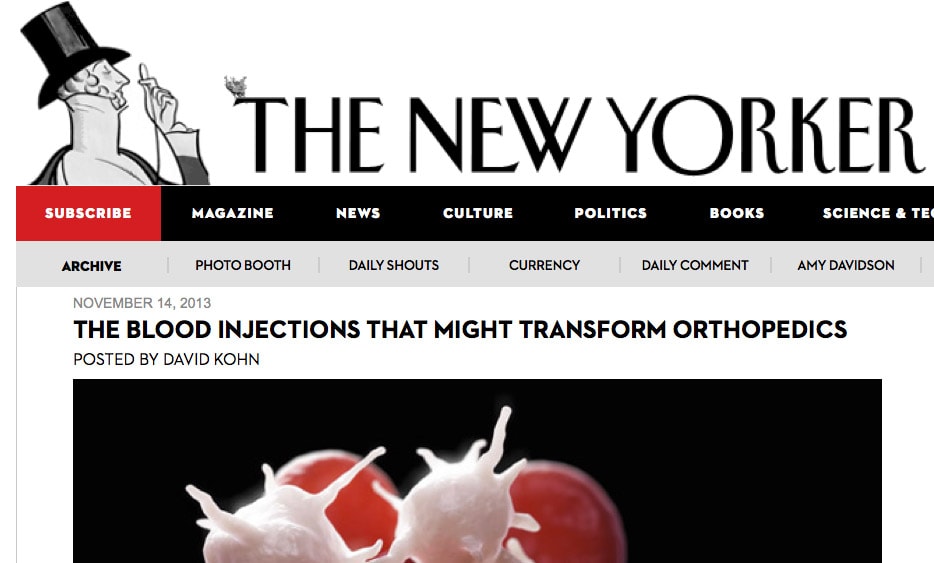
An excellent article was posted this month at The New Yorker’s online hub – newyorker.com
The article looks at PRP treatments, with the story of Chris Waddell, an athlete who was paralyzed in a college skiing accident, but went on to accomplish amazing athletic achievements including five gold medals in the Paralympic Games. After experiencing a rotator cuff tear and torn biceps tendon, he tried rehab, exercises and cortisone shots with limited success. Facing surgery, he decided to try PRP. His return to health has been remarkable.
Read the Story Here
StemCell ARTs offers the nations most advanced Stem Cell and PRP procedures. Learn more about how our PRP is different here.
Nov 13, 2013 | Prolotherapy, PRP, Spine and Neck
[youtube id=”bxN9BcfgBYQ” width=”600″ height=”350″]
The Sacroiliac (SI joint) is where the spine attaches to the pelvis in the lower part of the back. While not moving much (only about 3 degrees), the motion of this joint is very important for communication between the back and the pelvis when we walk or transition from sitting to standing. The joint absorbs all the forces of the upper body before balancing and transferring the weight to the hips and legs.
The SI joint can be twisted in a fall, or the pelvis can expand during a pregnancy and never return to the proper position. The result is that the ligaments are stretched, and lose some of their elasticity (similar to an overstretched rubber band). The SI joint will then over-rotate and potentially lock in one position. It changes the mechanics of the entire back, causing severe pain. The sacrum, which is part of the SI joint, attaches to the L5S1 disc just above it. If the sacrum is not functioning properly, it adds additional load on the disc connected to it, potentially causing a tear in the disc. The result is chronic pain when bending, twisting, getting up and down, and lifting heavy objects. The ligaments in the joint continue to stretch over time and the symptoms come on more frequently.
SI Joint Injury: How is it identified?
An injury to the SI joint can be a common source of pain in the lower back, buttocks, groin and legs. With these generalized symptoms, it can be easily confused with other causes of back pain. Additionally, this type of injury often does not show up on x-ray or MRI, making detection difficult.
To confirm diagnosis of an SI Joint injury, a local anesthetic or nerve block is administered at the site of the SI joint to accurately pinpoint whether the joint is the source of pain. If pain is relieved, it works towards confirming the diagnosis. The diagnosis is further confirmed through a review of patient history, a physical examination and other diagnostic tests. Once diagnosed, a treatment plan, utilizing part or all of the following, can be developed to jump start healing.
Prolotherapy
Prolotherapy contains a solution of concentrated dextrose and local anesthetic (steroids are not used). This solution irritates the tissue just enough to stimulate the body’s natural ability to heal, encouraging new growth and causing the tissue to heal faster and stronger.
Platelet Rich Plasma
Platelets initiate tissue repair by releasing growth factors. These growth factors start the healing process by attracting cells that repair us, including critical stem cells. Platelet Rich Plasma therapy intensifies this process by delivering a higher concentration of platelets. The therapy involves a small sample of the patient’s blood placed in a centrifuge to separate the platelets from the other blood components. The concentrated PRP is then injected into and around the point of injury, significantly strengthening the body’s natural healing. Our process for PRP is much different and sets us apart. Because our samples are all hand processed, we are able to produce PRP that is free of contaminating red and white cells, which can inhibit repair. This same special process also allows us to customize the concentration and volume for each individual and each injury type. This greatly improves outcomes.
It is through these treatments that a solution for recovery from an SI joint injury can be developed, instead of merely masking the symptoms. The result can be dramatic reduction in pain and return to mobility for the patient.

Oct 1, 2013 | Blog, PRP, Research
A group of researchers at University Hospital of Parma in Italy collaborated to demonstrate potential benefit of PRP application to muscle strains.
Drs. Gernuzzi, Petraglia, Pedrini, De Fillipo, Pogliacomi, Verdano, and Constantino have recruited a total of 53 patients who had an acute muscle tear of various muscles in their university emergency room. Patients recruited were all recreational athletes in different sports such as volleyball, soccer, basketball, and dancing.
Ultrasound was used to grade the tear, and only grade II (moderate) tear was recruited for the study and they all received PRP injections under ultrasound guidance for a total of 3 times, one week apart of each other. The study demonstrated these patients treated with PRP demonstrated clinically meaningful improvement in pain scale (as measured by visual analogue scale of pain), improvement in visual characteristic on ultrasound, and 100% of patients returned to their regular sporting activity within 30 days of the last injection. Only one patient experienced a relapse of the injury by one year follow up.
This study was unique in that it looked at the efficacy of PRP application to acute muscle injuries whereas most PRP studies have investigated its application to chronic tendinous / ligamentous injuries or cartilage lesions.
Time to improvement in this study was also unique. Most chronic tendinous injuries have been reported to have much slower response to PRP (weeks to months), this study has suggested muscular application of PRP may result in faster resolution of pain and recovery of function.
While this study suggested safety and potential benefit to PRP application to acute, moderate muscle tears, further study is warranted to compare PRP with conventional conservative treatment (a design known as a randomized control trial), and also, future studies should investigate the effect of PRP per different muscle types.
View Abstract: http://www.ncbi.nlm.nih.gov/pubmed/23867186
Jul 10, 2013 | Elbow, PRP, Research
Efficacy of platelet-rich plasma for chronic tennis elbow: a double-blind, prospective, multicenter, randomized controlled trial of 230 patients.
Abstract
BACKGROUND:
Elbow tenderness and pain with resisted wrist extension are common manifestations of lateral epicondylar tendinopathy, also known as tennis elbow. Previous studies have suggested platelet-rich plasma (PRP) to be a safe and effective therapy for tennis elbow.
PURPOSE:
To evaluate the clinical value of tendon needling with PRP in patients with chronic tennis elbow compared with an active control group.
STUDY DESIGN:
Randomized controlled trial; Level of evidence, 2.
METHODS:
A total of 230 patients with chronic lateral epicondylar tendinopathy were treated at 12 centers over 5 years. All patients had at least 3 months of symptoms and had failed conventional therapy. There were no differences in patients randomized to receive PRP (n = 116) or active controls (n = 114). The PRP was prepared from venous whole blood at the point of care and contained both concentrated platelets and leukocytes. After receiving a local anesthetic, all patients had their extensor tendons needled with or without PRP. Patients and investigators remained blinded to the treatment group throughout the study. A successful outcome was defined as 25% or greater improvement on the visual analog scale for pain.
RESULTS:
Patient outcomes were followed for up to 24 weeks. At 12 weeks (n = 192), the PRP-treated patients reported an improvement of 55.1% in their pain scores compared with 47.4% in the active control group (P = .163). At 24 weeks (n = 119), the PRP-treated patients reported an improvement of 71.5% in their pain scores compared with 56.1% in the control group (P = .019). The percentage of patients reporting significant elbow tenderness at 12 weeks was 37.4% in the PRP group versus 48.4% in the control group (P = .143). Success rates for patients at 12 weeks were 75.2% in the PRP group versus 65.9% in the control group (P = .104). At 24 weeks, 29.1% of the PRP-treated patients reported significant elbow tenderness versus 54.0% in the control group (P = .009). Success rates for patients with 24 weeks of follow-up were 83.9% in the PRP group compared with 68.3% in the control group (P = .037). No significant complications occurred in either group.
CONCLUSION:
No significant differences were found at 12 weeks in this study. At 24 weeks, however, clinically meaningful improvements were found in patients treated with leukocyte-enriched PRP compared with an active control group.
Am J Sports Med. 2014 Feb;42(2):463-71. doi: 10.1177/0363546513494359. Epub 2013 Jul 3.